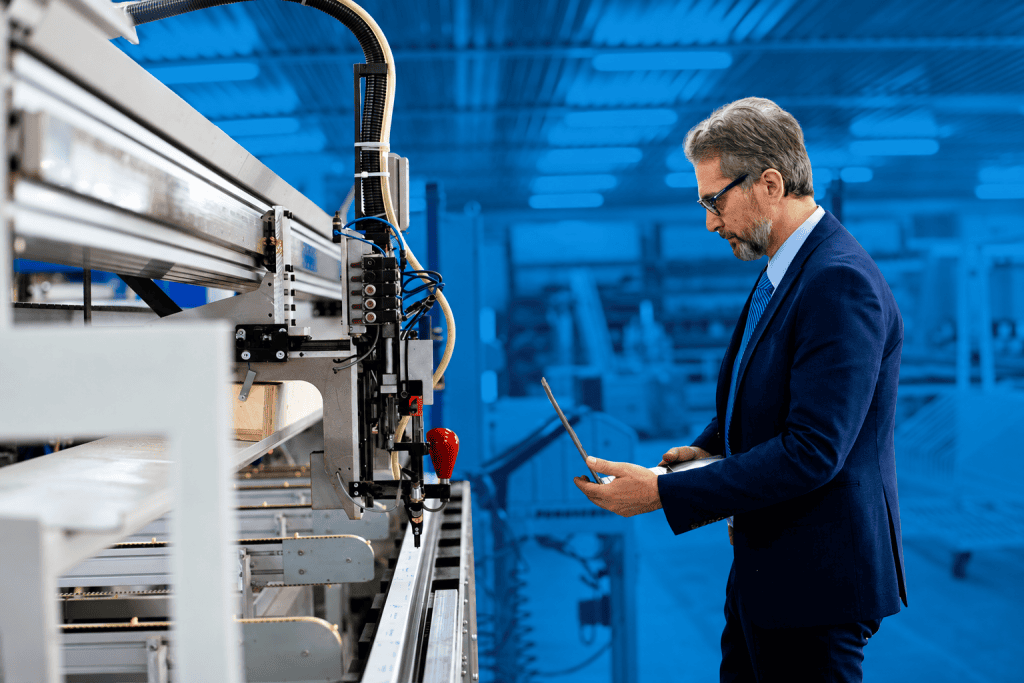
There’s a perfectly understandable reason why businesses keep using old machinery and equipment.
It still works.
If a machine starts every morning, produces what it’s supposed to produce and hasn’t completely broken down, replacing it can feel like an unnecessary expense. There are always other things a business could spend money on, and putting off a major purchase for another few months can seem like the sensible thing to do.
But “still works” isn’t necessarily the same thing as “still makes commercial sense”. As equipment gets older, the cost of keeping it can become less obvious, while the cost of replacing machinery can make businesses reluctant to invest even when the commercial case is beginning to change.
As equipment gets older, the cost of keeping it can become less obvious. A machine might still be doing its job, but taking longer to do it. It might need increasingly frequent repairs, create more downtime, or make it harder for employees to work as efficiently as they could. None of those costs shows up on the original purchase price or an invoice from a supplier, but they can have a very real impact on the business.
The cost of downtime
One of the biggest problems with ageing equipment is that you don’t necessarily know when it’s going to let you down. A planned maintenance visit is one thing. An unexpected breakdown in the middle of a busy production period is quite another.
The cost isn’t simply the repair bill. There may be lost production, delayed orders, overtime, wasted materials, or customers waiting longer than expected for their goods or services. For a business operating with tight margins or limited capacity, even relatively short periods of downtime can have real consequences.
And there’s another issue. If an older machine is becoming increasingly unreliable, the business may start building its working practices around the possibility that it will fail, rearranging jobs, finding temporary workarounds, spending time on problems that shouldn’t really be there in the first place.
Repairs don’t tell the whole story
Repairing equipment is often the right decision. Replacing something simply because it’s getting older would rarely make good commercial sense on its own. The real question is whether the repairs are still an economical way of keeping the equipment in service.
A single repair might be relatively inexpensive. But several repairs over the course of a year can add up, particularly once the equipment reaches the point where other components are also becoming more likely to fail. There’s also the question of how much management time goes into dealing with it, finding parts, arranging engineers, rearranging work, dealing with the fallout of a breakdown – all of it takes time that could otherwise go into actually running the business.
The figure that matters isn’t necessarily the cost of the latest repair. It’s the overall cost of continuing to rely on the equipment at all.
Productivity can decline without anyone noticing
An ageing machine doesn’t have to stop working to become a problem; it can simply become less productive. Maybe it takes longer to complete each job, needs more frequent adjustments or cleaning, or newer equipment could produce more output with the same number of employees.
Small differences like that are easy to overlook when they develop gradually. If a machine has always operated at a particular speed, that speed can start to feel normal even when newer technology could do considerably more, and over time the gap can become significant without anyone quite clocking when it happened.
That doesn’t automatically mean replacing the equipment is the right answer. A new machine has a cost too, and any investment needs to be justified by what it’s actually expected to deliver. But productivity should form part of that calculation, rather than the decision simply coming down to whether the existing machine still switches on.
There can be a cost to your people too
Equipment affects more than production figures.
Employees generally want to be able to do their jobs effectively, and constantly dealing with unreliable machinery, inefficient processes or equipment that needs workarounds can be genuinely frustrating. It can also pile on extra pressure when staff have to compensate for equipment that isn’t performing as it should.
That’s not to say every old machine is quietly damaging morale. But when a business is weighing up whether to replace equipment, the impact on the people using it is worth considering alongside the financial numbers, since good equipment should help employees do their jobs, not routinely make them harder.

What opportunities are you missing?
There’s another cost that can be much harder to identify, because it doesn’t necessarily show up anywhere in the accounts: the opportunities a business can’t take because its existing equipment has reached its limits.
A machine operating close to capacity may still be perfectly reliable, but if it takes two days to complete work that newer equipment could handle in one, that difference can affect how much work the business is able to accept. It could mean turning away an order because there isn’t enough capacity, quoting a longer lead time than a competitor, or deciding not to offer a particular service at all. After all, the right equipment simply isn’t there.
None of that means a faster or more capable machine will automatically create profitable growth; additional capacity only has value if there’s enough demand for it, and any investment needs to be weighed against the other costs involved. It is worth recognising, though, that keeping the existing equipment has consequences too. Saving money by postponing an investment can sometimes mean quietly accepting limits on what the business is actually able to do.
Looking at the whole picture
This is why deciding when to replace machinery is rarely as simple as comparing the price of a new machine with the cost of keeping the old one.
The machinery maintenance costs may be increasing as the equipment gets older, while it may also be taking longer to complete work and causing more disruption when something goes wrong. A replacement, meanwhile, may offer greater productivity, lower running costs or additional capacity, though those potential benefits still need to be weighed against the purchase price, installation, training and any other costs the investment brings with it.
Some of those figures will be relatively easy to establish. Others will involve estimates, particularly when it comes to the value of additional capacity or the amount of downtime that might be avoided. Even so, bringing them together tends to give a much more useful picture of the decision than simply asking whether the existing equipment still works.
There will also be plenty of situations where keeping the existing machinery is the right call. If it remains reliable, productive and economical to run, replacing it just because newer technology exists may not offer enough of a return to justify the investment. Older equipment isn’t automatically inefficient, and newer equipment isn’t automatically the better choice for every business; it depends entirely on what that particular business needs.
The important thing is to review the decision periodically rather than letting the fact that something still works settle the question by default. What made sense when the equipment was first bought may not make quite as much sense several years later, particularly if the business itself has changed in the meantime.
Funding the investment
Once a business has established that replacing equipment makes commercial sense, there’s a separate decision to make about how to fund it.
Using available cash may be appropriate in some circumstances, particularly where the business has sufficient reserves, and the investment won’t place unnecessary pressure on working capital. In other cases, spreading the cost through business finance can allow the company to invest while keeping cash free for the other demands of running the business.
There isn’t a single answer that suits every business, and the cost of finance is only one part of that decision. The expected benefits of the investment, the business’s cash position, and its ability to manage the repayments all need to be weighed up alongside the alternatives.
That’s why the starting point should be the equipment itself, and the role it actually plays in the business, rather than the finance available to pay for it. If replacing a machine isn’t likely to improve the business’s position, finding a way to fund the purchase won’t solve the underlying problem on its own. Once the investment is commercially justified, though, how it’s funded becomes a genuinely separate part of the decision.
The next time a machine starts making more noise, taking a little longer, or needing yet another repair, it may be worth looking past the immediate cost of fixing it. The more useful question is what that equipment is costing the business as a whole, and whether continuing to make do still represents the best use of its money.
Because sometimes the cost of keeping something, simply because it still works, is considerably higher than it first appears.
If you’re weighing up asset finance and want to understand what’s realistically available to you, we’re happy to have an initial conversation. There’s no obligation to proceed, and no cost to find out where you stand.
Follow us on LinkedIn, Facebook, and Instagram to stay up to date with everything Allied Business Finance.
Important information: Finance is subject to status, terms and conditions, and approval isn’t guaranteed. Spreading the cost of an asset or accessing working capital through finance typically means paying interest, so the total amount payable is usually higher than paying in full upfront. Agreements are generally fixed-term commitments and, depending on the size and structure of the finance, you may be asked to provide a personal guarantee, which means you could be personally liable if the business cannot meet its obligations. Finance isn’t right for every business or every situation and should be considered carefully against your own circumstances before proceeding. This content is for general information only and doesn’t constitute financial advice. Allied Business Finance is a credit broker, not a lender, and can introduce you to a range of finance providers.