
In today’s fast-moving business environment, maintaining strong cash flow is critical. Many businesses find themselves in a situation where they have valuable equipment, vehicles, or machinery, but much of their capital is tied up in those assets. Refinancing offers a practical solution, allowing businesses to release funds from assets they already own and reinvest that capital where it’s needed most.
Whether you’re looking to consolidate existing debt, reduce your monthly payments, or generate working capital to support expansion, refinancing can be a strategic and cost-effective way to strengthen your financial position.
What is Refinancing?
Refinancing is a form of asset finance that enables a business to unlock capital tied up in assets it already owns. Refinance is also available where finance is still outstanding on an asset provided there is sufficient equity between the current settlement figure and value of the asset.
This type of arrangement is usually available over a term similar to other finance agreements such as Hire Purchase or Lease, depending on the age and condition of the asset. Refinancing is particularly valuable for businesses that are asset-rich but cash-poor as it can transform existing, depreciating equipment into an active source of working capital.
The Benefits in Practice
Refinancing can deliver a wide range of financial and operational benefits. From lowering costs to simplifying financial management, it’s a practical tool that helps businesses realign their finances to match current goals and market conditions.
Financially, refinancing can provide immediate and measurable advantages. Refinancing by extending the term can reduce repayments to ease pressure on monthly outgoings, freeing up funds for day-to-day operations or reinvestment. This reduction in regular payments often leads to improved cash flow, giving businesses greater flexibility and predictability in managing their finances. In addition, refinancing can unlock access to extra capital. By leveraging the value of existing assets, businesses can raise a lump sum to fund growth projects, purchase new equipment, or manage seasonal dips in income; all without needing to sell or disrupt essential operations.
Beyond the direct financial benefits, refinancing also brings significant operational advantages. It can simplify business finances by consolidating multiple loans, leases, or credit facilities into a single, easier-to-manage agreement. This not only streamlines repayments but can also reduce administrative time and potentially lower overall costs. With one lender and one repayment schedule, businesses gain a clearer overview of their financial commitments, making it easier to plan and maintain control. Perhaps most importantly, refinancing allows companies to reshape their financial arrangements to reflect where they are today. A business that has grown or evolved since taking out its original finance can use refinancing to realign repayment terms, interest structures, and borrowing levels with its current size, strategy, and ambitions.
In essence, refinancing is more than just a cost-saving measure; it’s a way to strengthen both financial stability and operational efficiency, ensuring the business is better positioned for long-term growth.
What Can Refinancing Be Used For?
Not all assets are suitable for refinancing. Lenders typically look for equipment that retains its value over time.
Hard assets are the most commonly accepted for refinance. These are tangible items that:
- Are easily recognisable and identifiable – for example, vehicles, construction plant, engineering or manufacturing machinery.
- Have an established resale market where the finance company could reasonably recover a significant portion of the asset’s value.
Soft assets, on the other hand, such as IT equipment, office furniture, or software, generally depreciate too quickly to qualify for refinancing on their own. However, in some cases, soft assets can be financed when combined with hard assets of greater value.
Businesses commonly use refinancing for:
- Releasing working capital tied up in owned vehicles, machinery, or plant.
- Funding growth or expansion, such as opening new premises or hiring staff.
- Investing in new opportunities while retaining essential equipment.
- Improving liquidity to manage cash flow during slower trading periods.
How Does It Work in Practice?
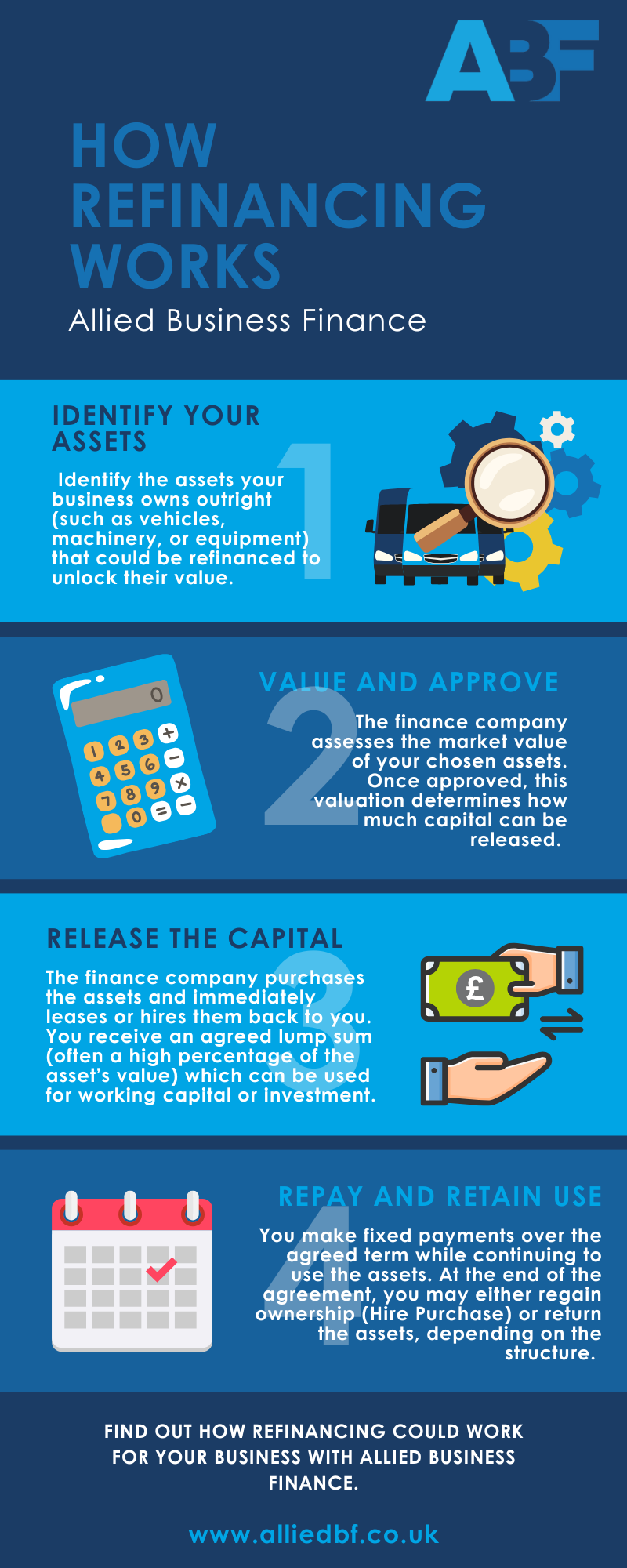 Refinancing follows a straightforward, structured process designed to be both efficient and transparent.
It begins with identifying the assets the business owns outright, such as vehicles, machinery, or equipment, that could be refinanced.
The finance company then assesses the current market value of these assets to determine how much capital can be released.
Once the valuation is agreed, the finance company enters into a HP or Lease Agreement with the client.
The business then receives an agreed lump sum, typically a high percentage of the asset’s value, which can be used as working capital or reinvested elsewhere in the business.
Regular repayments are made over a fixed term, and depending on the structure of the agreement, ownership may either return to the business at the end (as in a Hire Purchase arrangement) or the asset may be handed back.
The entire process is typically fast, efficient, and less complex than applying for a new loan or overdraft, making it an attractive option for businesses with valuable assets.
Is Refinancing Right for Your Business?
Refinancing can be an excellent option for businesses that:
- Own valuable equipment or vehicles outright.
- Need to improve cash flow or raise capital without taking on new unsecured debt.
- Are paying higher-than-market interest rates on existing loans.
- Want to simplify multiple finance agreements into a single manageable facility.
However, it’s important to consider the full financial picture. While refinancing can free up cash, extending loan terms may mean paying more interest over time. Additionally, as the assets act as security, they could be at risk if payments are not maintained.
That’s why it’s crucial to work with a finance partner, like Allied Business Finance, who understands your business and can help you choose the right structure – balancing immediate benefits with long-term sustainability.
The Bottom Line
Refinancing is a powerful tool for businesses seeking flexibility, liquidity, and growth. By turning existing assets into working capital, companies can strengthen their financial position without disrupting day-to-day operations.
Whether you’re looking to consolidate debt, lower repayments, or fund expansion, refinancing allows you to make your assets work harder for your business.
At Allied Business Finance, we work with businesses of all sizes to tailor refinancing solutions that align with their goals. Our team can help assess your assets, identify the most effective structure, and deliver a finance plan that supports both stability and growth.
Refinance with confidence — and keep your business moving forward.
If you’d like to explore how Refinancing could work for your business, get in touch with us at Allied Business Finance. Drop us an email at [email protected] or complete our short contact form, and one of our specialists will be happy to help.
And don’t forget, if you want to learn more about asset finance and its various forms, we’ve already covered:
Follow Allied Business Finance on LinkedIn, Facebook, and Instagram to stay up to date with Allied Business Finance.