
When your business is growing, having the right equipment, vehicles, or machinery can make all the difference. The challenge, of course, is that buying these assets outright often ties up valuable cash – cash you’d probably rather use for staff, stock, or marketing. That’s where asset finance comes in.
In this blog, we’ll take a closer look at how Hire Purchase works, why statistically it’s such a favourite with UK businesses, and whether it might be an option you wish to consider for your business.
What is Hire Purchase?
Hire Purchase (often shortened to HP) is a straightforward way of buying an asset while spreading the cost. Instead of paying the full amount upfront, you agree to pay in instalments over a fixed period. The finance company owns the asset while you’re paying it off, and once the final instalment and a small purchase fee are paid, ownership transfers to you.
That’s the key difference between Hire Purchase and leasing: with HP, once the final payment and the option to purchase fee on the agreement has been paid, you will own the asset outright. Until then, the lender legally owns the asset, so if you default, the lender has the right to repossess. This enables lenders to be more comfortable offering Hire Purchase as a finance option to UK businesses.
Like any finance product, the terms are important. You’ll see everything set out clearly in the agreement, including fees, charges, and your responsibilities.
Why is Hire Purchase so popular?
Hire Purchase remains the most widely used form of asset finance in the UK, and for good reason. According to the Finance & Leasing Association (FLA), it regularly accounts for over half of all business asset finance agreements, nearly double that of leasing. In 2024, Hire Purchase accounted for £20.bn (54.19%) of funding compared to £10.1bn (26.44%) in Operating Leases.
The appeal comes down to three main things: predictability, ownership, and flexibility.
Firstly, HP gives you fixed monthly repayments. That makes it much easier to plan cash flow and budgets because you know exactly what’s going out each month, with no nasty surprises. Secondly, you’re working towards full ownership of the asset, so there are no ongoing rental fees once the agreement is complete. And thirdly, terms can be tailored to suit your business, whether you want a shorter deal or to spread payments over a longer term.
It’s this blend of certainty and flexibility that makes HP attractive for both established businesses and SMEs just starting out.
The Benefits in Practice
An advantage of Hire Purchase is the low initial outlay. Many agreements only require a small deposit (sometimes as little as 5%), meaning you don’t have to drain your working capital just to acquire new kit. The VAT is paid upfront too; however, if you’re VAT-registered, some finance companies may agree a VAT deferral for a period of up to three months. This allows you the flexibility to reclaim the VAT from HMRC in your next return and ensures that you are not burdened with a large VAT payment upfront, making it easier to manage your business cashflow.
There are also longer-term benefits. Every instalment you make goes towards eventual ownership, so the asset becomes part of your balance sheet. That means you’re not just paying to use it; you’re investing in your business. In some cases, you may also benefit from tax relief through claiming capital allowances or offsetting interest charges; though it’s always wise to check with your accountant to confirm what applies to you.
Most importantly, Hire Purchase helps preserve your cash for other priorities. Rather than tying up large sums in one purchase, you can spread the cost, keep liquidity in the business, and invest in growth where it matters most.
What can Hire Purchase be used for?
One of the reasons HP is so versatile is that it can cover such a wide range of assets. For many businesses, that might mean vehicles – anything from cars and vans to HGVs and coaches. But it doesn’t stop there. Manufacturers use it for plant and machinery, construction firms for heavy equipment, farmers for tractors and harvesters, and offices for IT systems and furniture.
In recent years, we’ve also seen more businesses using Hire Purchase to invest in sustainability, things like solar panels or energy-efficient machinery that reduce long-term running costs. Essentially, if it’s a tangible asset that your business needs to grow, there’s a good chance Hire Purchase can help you fund it.
How does it work in practice?
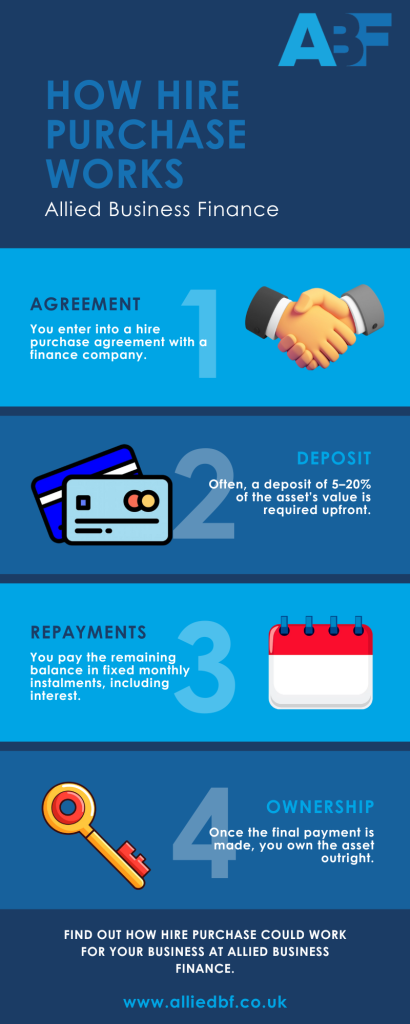 The process is designed to be straightforward. You agree the purchase with the supplier, and the finance company buys the asset on your behalf.
You then pay a deposit, typically between 5% and 20% of the asset’s value, and spread the remaining cost over a fixed term — usually anywhere from one to five years.
During that time, you make regular monthly repayments.
Once the final payment and option to purchase fee have been made, the asset legally becomes yours.
If you want to end the agreement early, most lenders will allow early settlement, though terms vary, and there may be a charge.
Otherwise, you simply continue paying until the agreement ends.
Is Hire Purchase right for you?
Hire Purchase suits businesses that want to own the asset at the end of the agreement, while still keeping cash flow under control. It also works well for businesses investing in equipment with a long useful life; things you’ll still want long after the finance term is up.
The Bottom Line
Hire Purchase is popular for a reason: it’s simple, predictable, and flexible. It helps you spread the cost of essential equipment, preserve your working capital, and build real value on your balance sheet. For businesses looking for a straightforward way to fund growth without placing unnecessary pressure on cash flow from purchasing assets outright, it’s a proven option that continues to stand the test of time.
If you’d like to explore how Hire Purchase could work for your business, get in touch with us at Allied Business Finance. Drop us an email at [email protected] or complete our short contact form, and one of our specialists will be happy to help.
And don’t forget, we’ll be covering other finance options like Finance and Operating Leases, Refinancing, and PCP in upcoming blogs. Follow us on LinkedIn, Facebook, and Instagram to stay updated.